
Contents
- 1 How to Rank High on Google with SEO
- 1.1 Introduction
- 1.2 What is SEO?
- 1.3 How Google Ranking Works
- 1.4 Why SEO Matters More Than Ever
- 1.5 Keyword Research — The Starting Point
- 1.6 Search Intent — The Secret Nobody Talks About
- 1.7 On-Page SEO — Optimizing What is On Your Website
- 1.8 Off-Page SEO and Backlinks
- 1.9 Technical SEO — The Engine Under the Hood
- 1.10 Local SEO — Winning Your City
- 1.11 Content Optimization and Blogging for SEO
- 1.12 User Experience, Mobile SEO, and Page Speed
- 1.13 Common SEO Mistakes Beginners Make
- 1.14 White Hat vs Black Hat SEO
- 1.15 Google Search Console Basics
- 1.16 SEO Tools Every Beginner Can Use
- 1.17 How Long Does SEO Actually Take?
- 1.18 Practical Tips to Rank High on Google Faster
- 1.19 The Future of SEO
- 1.20 Frequently Asked Questions
- 1.21 Conclusion
- 1.22 Suggested SEO Title Variations
- 1.23 Suggested Focus Keywords
- 1.24 Internal Linking Suggestions
- 1.25 External Linking Suggestions
- 1.26 Suggested Image Ideas
How to Rank High on Google with SEO
Introduction
Let me tell you a quick story.
A small bakery in Pune had a beautiful website, great products, and zero visitors from Google. The owner had never heard of SEO. Every day, hundreds of people nearby were searching “best bakery near me” and finding competitors instead.
Three months after learning Search Engine Optimization, her website began to rank high on Google for every local search that mattered. Her orders doubled.
That is the power of SEO. And it is available to any business, blogger, or brand willing to learn it.
If you want to rank high on Google, this guide is your starting point. No jargon. No confusion. Just clear, practical knowledge that actually works.
As the best ai digital marketer in india will tell you, SEO is not a one-time task. It is a long-term investment that compounds over time and builds organic traffic no paid ad budget can match.
Let us get into it.
What is SEO?
SEO stands for Search Engine Optimization.
In plain English, it is the practice of making your website easy for Google to find, understand, and trust. When someone types a question into Google, thousands of websites compete to appear in results. SEO determines which ones show up first.
Think of Google as an intelligent librarian. It scans millions of websites and picks the ones that best answer each question. SEO is the process of making your website the one the librarian picks.
There are three main types of SEO:
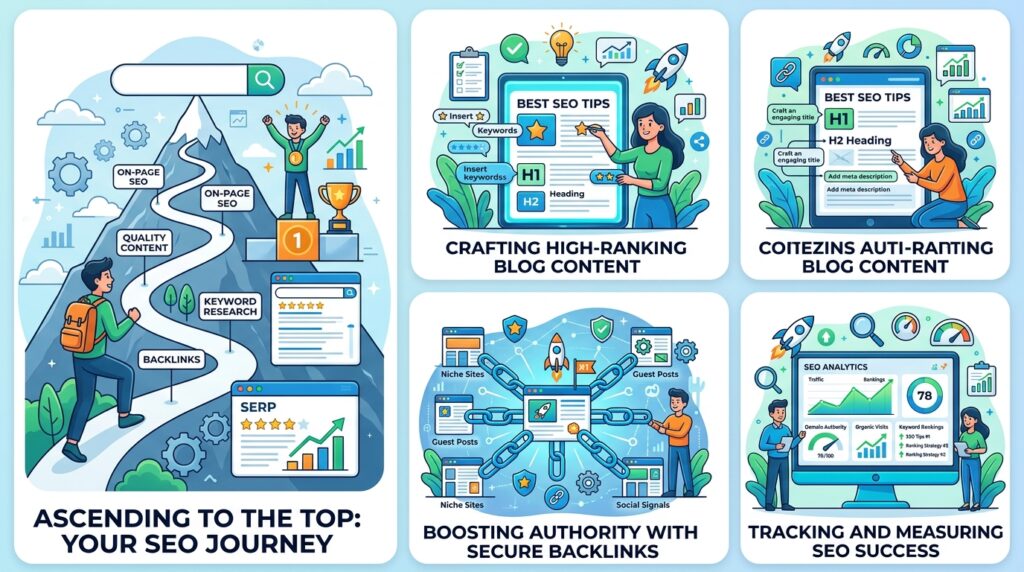
- On-page SEO — what you do directly on your website
- Off-page SEO — what happens outside your website
- Technical SEO — the behind-the-scenes foundation
All three work together. Mastering each one is how you consistently rank high on Google. Moz Beginner’s Guide to SEO is the most trusted beginner SEO resource globally.
How Google Ranking Works
Google uses a complex algorithm to decide which pages rank high on Google and which do not. Nobody knows every detail — Google keeps it confidential. But years of research have revealed the most important factors.
Relevance — Does your content answer the user’s question accurately?
Authority — Does Google trust your website? Authority is built through quality backlinks from other reputable sites.
Experience — Is your website fast, mobile-friendly, and easy to navigate?
Search intent match — Does your content match what the user actually wanted to find?
When Google decides to rank high on Google a specific page, it is essentially saying this page best serves the person who made that search. Your job is to prove — consistently and over time — that your content deserves that position.
Why SEO Matters More Than Ever
Over 8.5 billion searches happen on Google every day – which is why every best ai digital marketer in india prioritizes organic search.
Every one of those searches is a person looking for something — an answer, a product, a service. If your website does not rank high on Google, you are invisible to all of them.
Paid advertising drives traffic temporarily. The moment you stop paying, the traffic stops. SEO builds organic traffic that keeps flowing without ongoing ad spend. A well-optimized blog post published today can drive visitors for years.
The ability to rank high on Google through organic search is one of the most valuable long-term assets any business can build. It requires time and effort — but the return compounds in a way paid advertising never does.
Keyword Research — The Starting Point
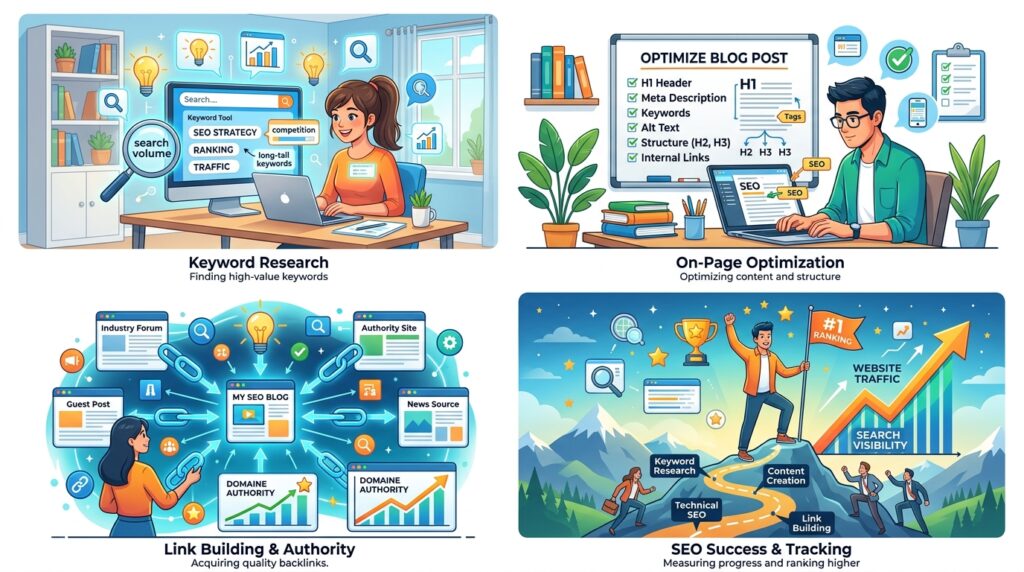
You cannot rank high on Google without knowing what people are actually searching for. That is what keyword research solves.
Keyword research identifies the exact words and phrases your audience types into Google. If your content targets the right keywords, Google connects your pages with the right searchers.
Here is how to start:
Use Google itself. Type your topic into Google and study the autocomplete suggestions, the “People Also Ask” box, and the “Related Searches” at the bottom. These are real searches real people are making.
Target long-tail keywords. These are longer, specific phrases. “Best SEO tools for beginners in India” is more specific than “SEO tools.” Long-tail keywords have lower competition and higher intent — people searching them are closer to taking action.
Check volume and competition. Tools like Google Keyword Planner and Ubersuggest show monthly search volume and competition level. Beginners should target keywords with decent volume and lower competition to build early wins.
Getting keyword research right is the foundation everything else is built on – something every best ai digital marketer in india will confirm.
Search Intent — The Secret Nobody Talks About
Search intent is the reason behind a search query. It might be the most important concept in all of SEO — and most beginner guides skip it entirely.
Google has become very good at understanding what a searcher actually wants. It rewards content that matches that intent precisely.
The four types of search intent:
Informational — The person wants to learn something. Create educational guides and blog posts.
Navigational — The person wants a specific website. The official site always wins here.
Commercial — The person is researching before buying. Comparison articles and reviews work best.
Transactional — The person is ready to buy. Product pages and landing pages rank best.
If you write an informational article trying to rank high on Google for a transactional keyword, Google will not rank it — because it does not match what the searcher wanted.
Always ask before creating content: what does the person who searched this actually want? Then create exactly that.
On-Page SEO — Optimizing What is On Your Website
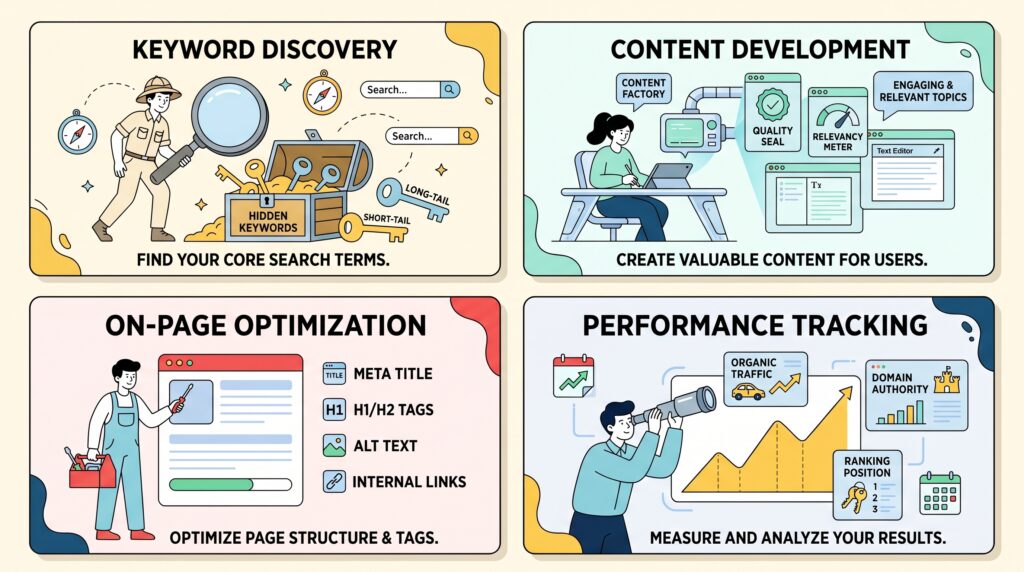
On-page SEO covers everything you do directly on your web pages to help Google understand your content and rank high on Google for relevant searches.
Title tag — The clickable headline in search results. Include your primary keyword naturally and keep it under 60 characters.
Meta description — The short paragraph below your title. It does not directly affect ranking but significantly affects click-through rate. Write it to be genuinely compelling.
Headings — Use one H1 as your main title. Use H2 for major sections. Use H3 for subsections. This structure helps Google understand your content hierarchy.
Keyword placement — Include your focus keyword naturally in the first 100 words, in at least one H2 heading, and throughout the body — only where it fits naturally. Forcing keywords kills readability.
URL structure — Keep URLs short and descriptive. yoursite.com/rank-high-on-google is far better than yoursite.com/page?id=2847.
Image alt text — Every image should have a short description telling Google what it shows.
Internal links — Link to other relevant pages on your own website. This helps Google discover your content and understand how pages relate to each other.
Off-Page SEO and Backlinks
On-page SEO makes your content understandable. Off-page SEO makes it trustworthy.
The most important off-page SEO signal is backlinks, links from other websites pointing to yours. When a reputable site links to your content, Google interprets it as a vote of confidence. The more quality backlinks you earn, the higher your site’s authority and the easier it becomes to rank high on Google across all your pages.
Think of the internet as a city. Every website is a building. Backlinks are the roads connecting them. The more quality roads that lead to your building, the more important Google assumes you must be.
How to build backlinks as a beginner:
Create link-worthy content. Original research, comprehensive guides, and unique data attract links naturally.
Guest posting. Write articles for reputable websites in your industry and earn a link back to your site.
Broken link building. Find broken links on other sites and suggest your content as a replacement.
Quality matters far more than quantity. Ten links from highly trusted sites are worth more than a hundred links from low-quality sources.
Technical SEO — The Engine Under the Hood
You could have perfect on-page SEO and strong backlinks — but if your technical SEO is broken, you will struggle to rank high on Google.
Technical SEO ensures Google can find, crawl, and index your website without errors.
Sitemap — Submit an XML sitemap to Google Search Console so Google knows every page exists.
HTTPS — Google uses HTTPS as a ranking signal. Move to HTTPS immediately if you have not already.
Crawl errors — Check Google Search Console regularly for pages Google could not access. Fix them promptly.
Structured data — Schema markup helps Google understand your content in richer detail, enabling features like star ratings and FAQ boxes in search results.
Canonical tags — If you have duplicate content at multiple URLs, canonical tags tell Google which version is the original.
Local SEO — Winning Your City
If your business serves customers in a specific area, local SEO is one of the fastest paths to rank high on Google for searches in your city.
Google Business Profile — Claim and fully optimize your profile. Add accurate information, photos, services, and collect genuine customer reviews.
Local keywords — Include location-specific keywords naturally in your content. “Best tuition in Faridabad” or “digital marketing agency in Chennai” are examples of local keywords with high commercial intent.
Local citations — List your business consistently across online directories. Consistent name, address, and phone number strengthens your local SEO signal.
Reviews — Genuine customer reviews are among the most powerful local ranking factors. Encourage satisfied customers to leave Google reviews and respond to all of them professionally.
Content Optimization and Blogging for SEO
Content is the foundation of every successful SEO strategy – a principle every best ai digital marketer in india lives by. Google’s mission is to surface the most helpful, accurate content for every search — and the websites that best serve that mission rank high on Google consistently.
Great SEO content:
Fully answers the question. Do not write 300 words on a topic that deserves 2,000. Google strongly favors comprehensive content that covers a topic thoroughly.
Is structured for readability. Short paragraphs. Clear headings. Bullet points where appropriate. Well-structured content keeps readers on the page longer — a signal Google uses to evaluate quality.
Is updated regularly. Outdated content loses rankings. Review and refresh important pages at least once a year.
Targets a specific audience. Generic content that tries to serve everyone rarely serves anyone well enough to rank.
Blogging is one of the most effective long-term strategies any best ai digital marketer in india recommends to rank high on Google. Each post is an opportunity to target a specific keyword and attract a specific segment of your audience. Over time, a well-maintained blog builds topical authority — making it progressively easier to rank new content faster.
User Experience, Mobile SEO, and Page Speed
Google pays close attention to how users behave on your website after clicking from search results.
If users click your link, spend thirty seconds on your page, and immediately return to Google — that signals your content did not satisfy them. Do this consistently and Google will lower your ranking.
Mobile SEO is non-negotiable. Google uses mobile-first indexing — meaning it primarily uses the mobile version of your website to determine your Google ranking. A site that looks great on desktop but breaks on mobile will rank poorly regardless of content quality.
Page speed is a confirmed ranking factor. Google’s Core Web Vitals — Largest Contentful Paint, First Input Delay, and Cumulative Layout Shift — measure specific aspects of page experience and directly affect your ability to rank high on Google. Check your scores in Google Search Console and PageSpeed Insights, and improve them by compressing images, reducing unnecessary code, and improving server response time.
Common SEO Mistakes Beginners Make
Knowing what not to do is as valuable as knowing what to do.
Targeting keywords that are too competitive. A brand new website cannot rank for “best smartphone” on day one. Start with specific, lower-competition keywords.
Ignoring search intent. Creating the wrong type of content for a keyword guarantees poor rankings regardless of quality.
Buying backlinks. Paid links violate Google’s guidelines. Penalties can be severe and long-lasting.
Publishing thin content. Short, shallow articles do not rank well. Depth and genuine helpfulness are what Google rewards.
Expecting overnight results. Anyone who wants to rank high on Google must accept that SEO is a long-term strategy. Expecting results within days leads to frustration and poor decisions.
White Hat vs Black Hat SEO
White hat SEO means following Google’s guidelines — creating genuine value, earning backlinks naturally, and building a website that truly serves its users. It takes longer but produces durable, compounding results.
Black hat SEO uses manipulative techniques — buying links, keyword stuffing, creating fake content — to trick Google’s algorithm. It may produce short-term spikes but Google’s algorithm gets smarter every year. Penalties can wipe out years of traffic overnight.
Build for the long term. Play by the rules. It pays better — always.
Google Search Console Basics
Google Search Console is a free tool every website owner should use. It shows exactly how your site performs in Google search.
Performance report — Shows which keywords your pages rank for, how many impressions and clicks you are getting, and your average position for each keyword.
Coverage report — Shows which pages Google has indexed and flags errors preventing indexing.
Core Web Vitals report — Shows your page experience scores across your site.
Sitemap submission — Submit your sitemap directly so Google can find and crawl all your pages efficiently.
Check Search Console at least once a week – it is a non-negotiable habit for every best ai digital marketer in india. It is the most direct feedback available for understanding how your SEO efforts are performing.
SEO Tools Every Beginner Can Use
You do not need expensive tools to start building SEO skills.
- Google Search Console — Free. Essential.
- Google Analytics — Free. Shows where traffic comes from and how users behave.
- Ubersuggest — Affordable keyword research tool. Great for beginners.
- Ahrefs or SEMrush — More advanced. Powerful for keyword research, backlink analysis, and competitive intelligence.
- Yoast SEO or Rank Math — WordPress plugins that guide on-page SEO optimization.
- Google PageSpeed Insights — Free page speed checker.
- AnswerThePublic — Shows questions people ask around any keyword. Excellent for content ideas.
Start free. Invest in paid tools as your results grow. This is the path every best ai digital marketer in india followed.
How Long Does SEO Actually Take?
For new websites, expect three to six months before seeing meaningful organic traffic. For competitive keywords, it can take twelve months or longer to rank high on Google consistently.
For lower-competition keywords and local SEO, results can come in four to eight weeks with proper optimization.
The key insight is that SEO compounds. A blog post published and properly optimized today can drive traffic for five years. Patience combined with consistent execution is the most reliable formula for long-term success.
Practical Tips to Rank High on Google Faster
Go after low-competition keywords first. Early wins build authority and momentum.
Update existing content before creating new content. Refreshing an underperforming page is often faster than creating a new one from scratch.
Fix technical issues immediately. Crawl errors and slow pages act as a ceiling on your rankings.
Build topic clusters. Create a pillar page on a broad topic supported by multiple cluster articles on specific subtopics. This architecture builds topical authority faster.
Optimize for featured snippets. Format content to directly answer specific questions using clear headers and short answer paragraphs. Featured snippets appear above all other results and dramatically increase click-through rate.
The Future of SEO
SEO is not dying. It is evolving faster than ever.
AI-powered search tools like ChatGPT, Perplexity, and Google’s AI Overviews are changing how people find information. New disciplines — AEO (Answer Engine Optimization) and GEO (Generative Engine Optimization) — focus on visibility inside AI-generated answers, not just traditional search results.
Voice search is growing. Conversational, question-based content optimized for natural language queries is increasingly important.
The brands and every best ai digital marketer in india who will continue to rank high on Google five years from now are those building for both traditional search and AI search simultaneously. Quality, helpfulness, and genuine expertise are the constants every best ai digital marketer in india builds on that survive every algorithm update and every platform shift.
Frequently Asked Questions
How long does it take to rank high on Google? For new websites, three to six months for initial results. For competitive keywords, up to twelve months. Local SEO and low-competition keywords can show results in four to eight weeks.
What is the most important factor to rank high on Google? There is no single factor. Quality content matching search intent, combined with strong backlinks and solid technical SEO, consistently produces the best results.
Can I rank high on Google without backlinks? For very low-competition long-tail keywords, yes. For most competitive keywords, backlinks remain one of the strongest ranking signals.
What is the difference between on-page and off-page SEO? On-page SEO covers everything on your website — content, headings, meta tags, internal links. Off-page SEO covers everything outside your website, primarily backlinks, that builds your site’s authority.
Is SEO free? Organic traffic from SEO does not cost per click. But SEO requires investment in time, content creation, and tools. The return compounds over time in a way paid advertising does not.
How does Google decide what to rank high? Google evaluates hundreds of signals — content relevance, backlink quality, page experience, user behavior, and website authority. The core question is always: which page best serves the person who made this search?
Conclusion
SEO is one of the most powerful and sustainable growth strategies available today.
It is not complicated once you understand the fundamentals. Create content that genuinely helps people. Make your website technically sound. Build authority through quality backlinks. Optimize for the specific intent behind every search query. Stay consistent and patient.
The bakery owner who doubled her orders did not have a massive budget or a specialist team. She had the right knowledge applied consistently. That is all SEO requires.
Start with keyword research. Build your first piece of optimized content. Submit your sitemap to Google Search Console. Fix any technical issues. And then keep going — because SEO rewards the consistent over the clever.
If you found this guide helpful, share it with someone just starting their SEO journey. Every best ai digital marketer in india started exactly where you are right now.
Suggested SEO Title Variations
- How to Rank High on Google: A Beginner’s Complete SEO Guide
- Rank High on Google with These Proven SEO Strategies
- The Complete SEO Guide: How to get higher search visibility Fast
- How to appear at the top of search results Without Paid Ads
- SEO for Beginners: How to improve your Google ranking in Simple Steps
Suggested Focus Keywords
- achieve strong search rankings
- SEO for beginners
- how to improve google ranking
- search engine optimization tips
- on-page SEO checklist
- how to get organic traffic
- backlinks for beginners
- technical SEO basics
- local SEO guide india
Internal Linking Suggestions
- Link to your keyword research guide from the keyword research section
- Link to your backlink building article from the backlinks section
- Link to your local SEO guide from the local SEO section
- Link to your content marketing guide from the content optimization section
- Link to your Google Search Console tutorial from that section
External Linking Suggestions
- Google Search Console — search.google.com/search-console
- Google PageSpeed Insights — pagespeed.web.dev
- Google Keyword Planner — ads.google.com/home/tools/keyword-planner
- Ahrefs Blog — ahrefs.com/blog
- Search Engine Journal — searchenginejournal.com
Suggested Image Ideas
- A flowchart showing how Google crawls and ranks a website
- A diagram showing on-page vs off-page vs technical SEO
- A keyword research screenshot showing volume and competition
- A before and after traffic graph showing SEO results over time
- An infographic of the top Google ranking factors
- A mobile vs desktop comparison for mobile SEO section
- A screenshot of Google Search Console performance report