
Contents
- 1 Freelancing After MBA in Digital Marketing: A Practical Guide
- 2 Why Freelancing is Growing in Digital Marketing
- 3 Why an MBA in Digital Marketing Helps in Freelancing
- 4 Why Digital Scholar’s MBA in Digital Marketing is Useful for Freelancers
- 5 Skills You Need to Start Freelancing
- 6 Services You Can Offer After MBA in Digital Marketing
- 7 How Digital Scholar’s Syllabus Supports Freelancing
- 8 Importance of Trainers in Freelancing Growth
- 9 How to Get Your First Freelance Client
- 10 How Much Can You Earn as a Freelancer
- 11 Common Mistakes Beginners Should Avoid
- 12 Why AI Gives Freelancers an Edge
- 13 Freelancing vs Full-Time Job
- 14 Why Digital Scholar is a Smart Choice for Future Freelancers
- 15 Conclusion
- 16 FAQs on Freelancing After MBA in Digital Marketing
Freelancing After MBA in Digital Marketing: A Practical Guide
Freelancing after MBA in Digital Marketing explained in detail. Learn how to get clients, earn income, and grow with Digital Scholar’s practical course.
Introduction
Freelancing has changed the way many young professionals build their careers. Earlier, most students believed that the only path after graduation was getting a full-time job. Today, the market looks very different.
Businesses of every size need online marketing support, and many of them prefer hiring freelancers instead of building expensive in-house teams. This has opened a strong opportunity for students who complete an MBA in Digital Marketing.
Freelancing allows you to work independently, choose your clients, set your pricing, and build income based on skill rather than job titles. For students like Sahanah Hurakadli who want flexibility, faster growth, or even a future agency business, freelancing can be a smart direction. However, freelancing success depends heavily on practical knowledge. A student who only learns theory may struggle to deliver results, but a student trained in real tools, campaigns, and execution can start quickly.
This is why many students look at Digital Scholar’s MBA in Digital Marketing course. The program is known for practical training, modern syllabus, real projects, and industry-focused teaching. These elements help students become ready not only for placements, but also for freelancing opportunities. Digital Scholar is one of the best digital marketing institutes in Chennai offering various digital marketing courses.
In this guide, we will explore how freelancing works after an MBA in Digital Marketing, what skills you need, how to get clients, and why the right course can make the journey easier.
Why Freelancing is Growing in Digital Marketing
Digital marketing has become essential for every business. Whether it is a local restaurant, doctor, real estate company, startup, clothing brand, coaching center, or e-commerce seller, businesses need visibility online. They need leads, traffic, social media presence, ad campaigns, and consistent branding.
Many small and medium businesses cannot afford a full internal marketing team. Instead, they hire freelancers who can manage specific work such as social media, SEO, advertising, content writing, or website support. This creates strong demand for skilled independent professionals.
Freelancing is growing because it benefits both sides. Businesses save costs and gain flexibility, while freelancers earn based on results and skill. This trend is expected to grow even more in the coming years.
Why an MBA in Digital Marketing Helps in Freelancing
Many people assume freelancing only needs tool knowledge. In reality, successful freelancers need much more than that. They need to understand customer behavior, branding, pricing, communication, strategy, sales funnels, reporting, and client retention.
This is where an MBA in Digital Marketing becomes valuable. It combines management thinking with marketing execution. Instead of only knowing how to run ads, you learn why campaigns work, how customers decide, how brands position themselves, and how businesses grow.
That makes you more valuable than someone who only knows one tool. Clients often prefer professionals who understand business outcomes, not just technical tasks.
Why Digital Scholar’s MBA in Digital Marketing is Useful for Freelancers
The quality of your learning experience plays a major role in how quickly you can start freelancing. Some programs are too theoretical and focus only on exams. Others teach outdated modules that do not match current market demand.
Digital Scholar’s MBA in Digital Marketing course is different because it focuses on practical implementation. Students work on assignments, campaigns, strategies, and real-world tasks. This gives them confidence to handle actual clients later.
The course also follows an agency-style learning environment. This means students experience how real teams function, how deadlines are managed, how reporting is done, and how campaigns are planned. These are highly relevant freelancing skills.
Another advantage is the inclusion of AI and modern tools. Today’s freelancers need speed and efficiency. Knowing how to use modern marketing systems helps students deliver better output in less time.
Skills You Need to Start Freelancing
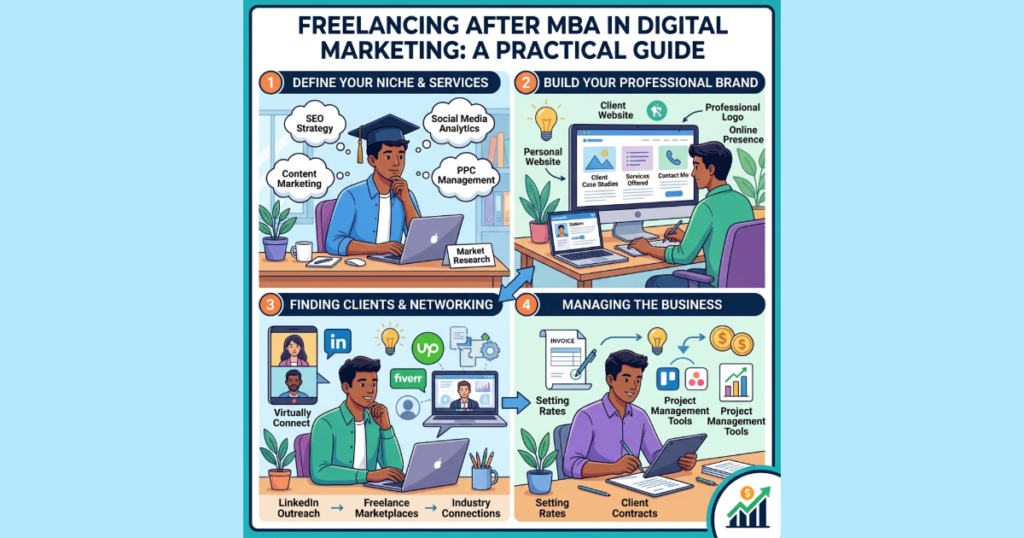
Freelancing success depends on two categories of skills: technical skills and business skills.
Technical skills help you deliver services. These may include social media management, paid advertising, SEO, content writing, website building, analytics, and email marketing.
Business skills help you retain and grow clients. These include communication, proposal writing, pricing, time management, client handling, and follow-up discipline.
Many talented people fail in freelancing because they know tools but cannot manage clients professionally. A good MBA in Digital Marketing helps students develop both sides.
Services You Can Offer After MBA in Digital Marketing
After completing your course, you can begin with one specialized service or a combination of related services.
Popular freelance services include:
- Social media management for brands
- Meta Ads lead generation
- Google Ads campaign management
- SEO for local businesses
- Content writing and blogging
- Website creation using WordPress
- Email campaign setup
- LinkedIn personal branding support
- Instagram growth consulting
It is usually better to begin with one strong niche rather than trying to sell everything at once. Specialization builds trust faster.
How Digital Scholar’s Syllabus Supports Freelancing
One reason many students prefer Digital Scholar is the market-relevant syllabus. Instead of limiting students to theory, the curriculum focuses on modern business needs.
Students learn modules such as SEO, Google Ads, Meta Ads, social media marketing, content strategy, website building, analytics, branding, email marketing, WhatsApp marketing, and AI tools.
These are not just academic subjects. They are direct revenue-generating skills in the freelance market. For example, a local clinic may need lead generation ads, a startup may need content strategy, and a retailer may need Instagram growth. Students trained in these areas can start offering services quickly.
Importance of Trainers in Freelancing Growth
The quality of trainers matters more than many students realize. If trainers only teach theory, students may know terms but not execution. If trainers have real industry experience, students learn practical shortcuts, common mistakes, client expectations, and growth systems.
Digital Scholar is known for trainers who understand real marketing work. This gives students valuable exposure to market realities.
Experienced mentors can guide students on:
- How to price services
- What results clients care about
- How to report performance monthly
- How to communicate professionally
- How to improve client retention
- How to grow from freelancer to consultant
This practical advice can save beginners months of trial and error.
How to Get Your First Freelance Client
The biggest fear many students have is getting the first client. In reality, the first client often comes through consistent action rather than luck.
Start by building a simple portfolio. Use course projects, sample campaigns, mock strategies, or internship work. Show what you can do clearly.
Then begin outreach. Many businesses need help but do not know whom to hire. Reach out to local businesses, startups, personal brands, doctors, coaches, realtors, and small stores.
Instead of selling immediately, start by offering value. You can show them gaps in their social media, suggest ad ideas, or point out website improvements. This creates trust and opens conversation.
Consistency matters. One message may not work. Fifty quality messages can.
How Much Can You Earn as a Freelancer
Freelancing income depends on skill, positioning, niche, and results.
Beginners may start with smaller monthly retainers. As confidence and results grow, pricing can increase significantly. Many freelancers earn more than entry-level jobs after building a few consistent clients.
For example, handling three clients with monthly retainers can already create stable income. Over time, you can move into premium consulting, ad management, or performance-based pricing.
The key is not starting with maximum pricing. The key is starting with value and improving continuously.
Common Mistakes Beginners Should Avoid
Many new freelancers struggle not because freelancing is hard, but because they make avoidable mistakes.
One common mistake is offering too many services. This creates confusion. Clear specialization helps clients trust you faster.
Another mistake is underpricing heavily. Cheap pricing may attract difficult clients who expect too much.
Poor communication is another issue. Clients value responsiveness and clarity. Even skilled freelancers lose business due to bad communication.
Finally, many people stop learning after completing a course. Digital marketing changes constantly. Continuous learning is essential.
Why AI Gives Freelancers an Edge
Modern freelancers who know AI tools can work faster and smarter. They can create first drafts quicker, improve research speed, generate content ideas, structure reports, and save time on repetitive work.
Digital Scholar’s MBA in Digital Marketing includes AI-focused learning, which helps students stay ahead in a competitive market. In coming years, freelancers who combine strategy with AI efficiency will have a clear advantage.
Freelancing vs Full-Time Job
Many students think they must choose only one path. That is not always true.
Some students start with a job to gain structure and freelance part-time. Others begin freelancing directly. Some build freelance income first and later launch agencies.
A job offers stability and team learning. Freelancing offers flexibility and income scalability. The best path depends on personality, risk comfort, and goals.
The good news is that digital marketing allows both paths.
Why Digital Scholar is a Smart Choice for Future Freelancers
Students planning freelancing need more than certificates. They need confidence, portfolio projects, modern tools, and execution ability.
Digital Scholar’s MBA in Digital Marketing helps because it focuses on practical learning, real projects, industry trainers, updated syllabus, AI integration, and market-ready skills.
This gives students a stronger base to start freelancing with clarity rather than confusion.
Conclusion
Freelancing after an MBA in Digital Marketing is one of the most practical career opportunities available today. Businesses everywhere need help growing online, and skilled freelancers can build rewarding careers by solving those problems.
But freelancing success does not come from theory alone. It comes from skill, consistency, communication, and confidence. That is why choosing the right learning environment matters.
Digital Scholar’s MBA in Digital Marketing course gives students hands-on exposure, current tools, real projects, and execution-focused training. These are exactly the ingredients needed to start and grow as a freelancer.
If you want freedom, flexible income, and the ability to build a career on your own terms, freelancing can be a powerful next step.
FAQs on Freelancing After MBA in Digital Marketing
1. Can I start freelancing after MBA in Digital Marketing?
Yes. If you have practical skills like ads, SEO, content, or social media management, you can start freelancing.
2. Is Digital Scholar good for freelancing?
Yes. Digital Scholar focuses on practical learning, projects, and industry-relevant execution skills.
3. How do beginners get freelance clients?
Through outreach, referrals, LinkedIn networking, local businesses, and a clear portfolio.
4. Which freelance service is best for beginners?
Social media management, content writing, Meta Ads, and SEO are common starting options.
5. Is freelancing better than a job?
It depends on your goals. Freelancing gives flexibility, while jobs offer stability. Many professionals do both.