
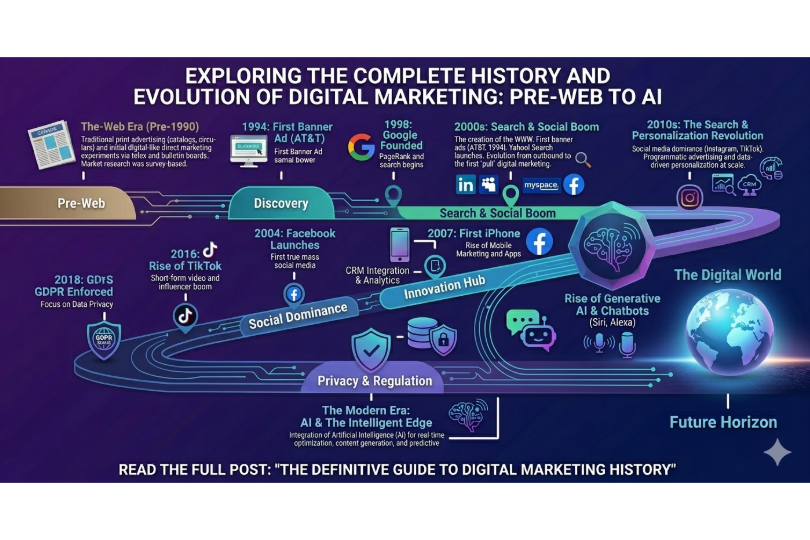
Contents
- 1 History and Evolution of Digital Marketing
- 1.1 Infographic: 5 Eras of Digital Marketing
- 1.2 Introduction
- 1.3 Era 1: The Birth of online marketing (1990-1995)
- 1.4 Era 2: Search Engines and the Dot-Com Boom – history and evolution of digital marketing continues (1996-2002)
- 1.5 Era 3: Social Media – the history and evolution of digital marketing shifts again (2003-2009)
- 1.6 Era 4: Content, Data and Mobile – history and evolution of digital marketing matures (2010-2015)
- 1.7 Era 5: AI and the Modern history and evolution of digital marketing marketing online Landscape (2016-Present)
- 1.8 Key Milestones in the History and Evolution of Digital Marketing
- 1.9 What Indian Experts Have Contributed to the History and Evolution of Digital Marketing
- 1.10 The Future – What Comes Next in the History and Evolution of Digital Marketing
- 1.11 Frequently Asked Questions
- 1.12 Conclusion
History and Evolution of Digital Marketing
Quick Answer: Digital marketing began in the early 1990s with the birth of the internet and the first clickable banner ad. Over three decades it evolved through search engines, email, social media, mobile, content marketing, and now AI-powered automation. Today the best AI digital marketer in India uses this full history as a strategic foundation. Understanding the history and evolution of digital marketing helps brands and marketers understand where the industry is heading and how to stay ahead of every major shift.
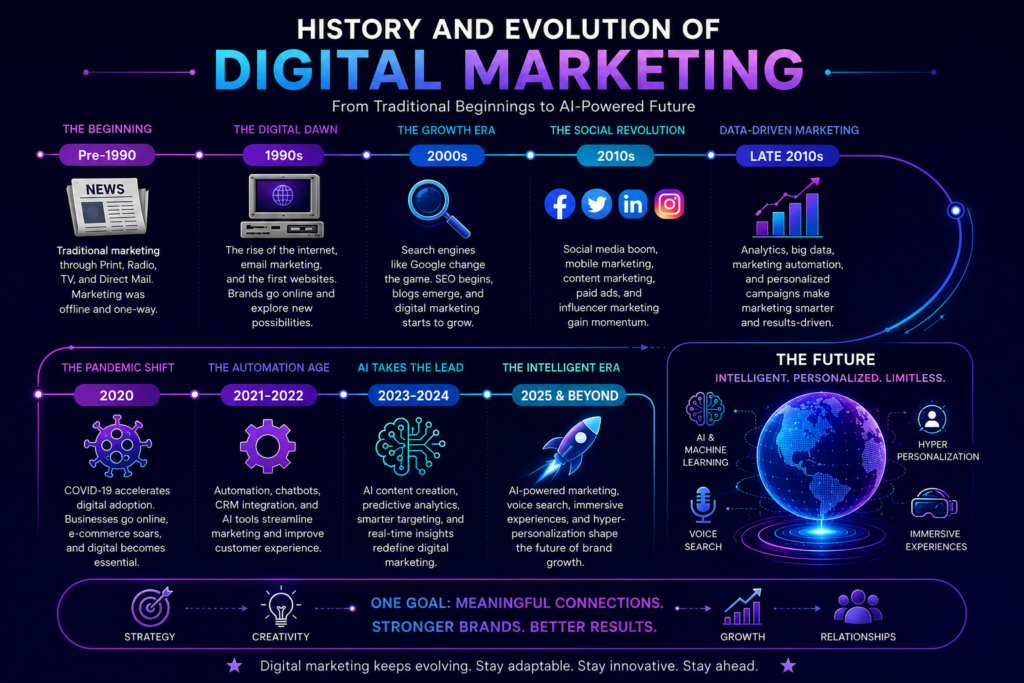
Infographic: 5 Eras of Digital Marketing
- 🟣 Birth Era (1991-1997) — WWW, first banner ad, first email, search engines
- 🔵 Search Era (1998-2002) — Google launch, AdWords, dot-com crash
- 🟢 Social Era (2003-2009) — Facebook, YouTube, Twitter, iPhone
- 🟡 Content and Data Era (2010-2015) — Content marketing, Google Panda, Big Data, Mobile
- 🔴 AI Era (2016-Present) — Programmatic ads, voice search, COVID acceleration, ChatGPT
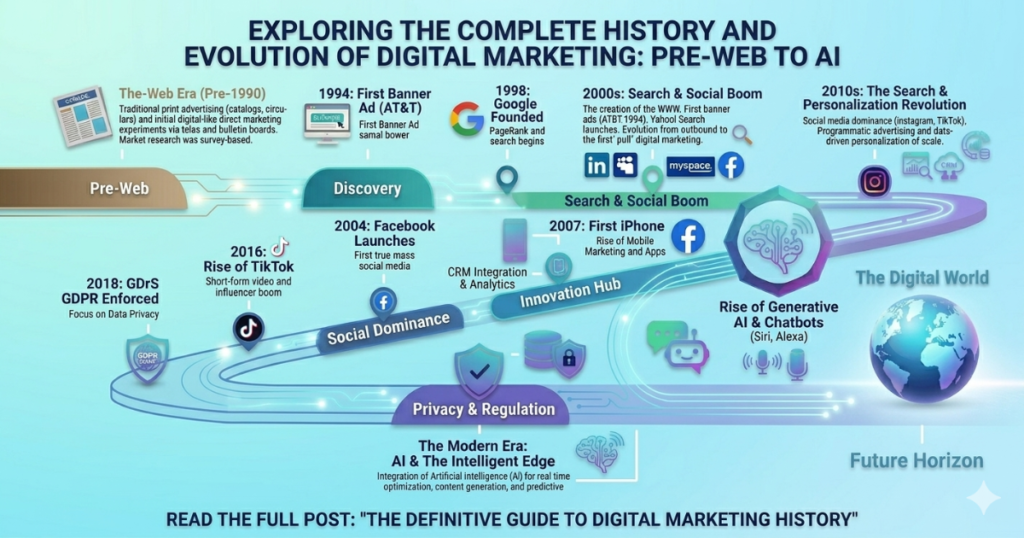
Introduction
Every industry has a defining moment – and the history and evolution of digital marketing has many — a point in time when everything changed and nothing ever went back to the way it was before.
For marketing, that moment came in 1994.
A law firm named Canter and Siegel sent the first mass commercial email to thousands of internet newsgroups advertising their immigration services. The internet community was outraged. But the message had been delivered. Digital marketing had arrived.
From that single, controversial moment — to the world of AI-powered personalization, voice search optimization, and generative engine marketing we live in today — the history and evolution of digital marketing is one of one of the clearest examples of transformation in the history and evolution of digital marketing in business history.
It is a story central to the history and evolution of digital marketing – technology changing faster than most brands could follow. Of platforms rising and falling. Of consumer behavior shifting in ways nobody predicted. And of the marketers who saw each shift coming — and built the strategies that took advantage of it.
This article traces the full history and evolution of digital marketing — from the first banner ad to the age of AI this practice — with insights from India’s leading practitioners who have lived through much of this evolution themselves.
Era 1: The Birth of online marketing (1990-1995)
The story of digital marketing begins not with a strategy but with infrastructure.
In 1991, the World Wide Web became publicly accessible. For the first time, information could be published online and accessed by anyone with an internet connection. It was a modest beginning — slow connections, text-heavy pages, no images — but the foundation had been laid.
1994: The First Banner Ad
The first clickable banner ad appeared on HotWired.com in October 1994. It was placed by AT&T and simply asked: “Have you ever clicked your mouse right here? You will.” The click-through rate was 44% — a number that seems impossible by today’s standards but reflected the novelty of the medium.
That single ad marked the official birth of this space as a commercial discipline.
1994: The First Spam Email
In the same year, Canter and Siegel’s mass email to newsgroups — while roundly criticized — demonstrated that the internet could be used for commercial outreach at scale. It planted the seed for email marketing, which would later become one of the most powerful digital marketing channels ever developed.
1995: Search Engines Emerge
Yahoo launched in 1995, followed by AltaVista, Lycos, and others. For the first time, users could search for specific information online. Brands quickly realized that appearing in these search results was valuable — and the early instincts that would eventually become SEO began to take shape.
The this practice ecosystem in this era was primitive by any modern standard. But the core insight — that the internet represented a new, direct channel to reach consumers — was already clear to the marketers paying attention.
Era 2: Search Engines and the Dot-Com Boom – history and evolution of digital marketing continues (1996-2002)
The late 1990s brought the dot-com boom — a period of explosive investment in internet businesses and the rapid development of this industry as a discipline.
1996-1998: Early SEO and Email Marketing
As search engines grew in importance, marketers began experimenting with techniques to improve their rankings. Early SEO was crude — keyword stuffing, hidden text, and directory submissions. But the fundamental insight was correct: appearing at the top of search results drove traffic and business.
Email marketing also began to mature. Companies built subscriber lists and started sending newsletters, promotional offers, and product announcements directly to consumers’ inboxes. The channel was new, open rates were high, and the return on investment was immediately apparent.
1998: Google Changes Everything
Google launched in September 1998. Within a few years it would become the dominant search engine globally, and its approach to search — based on the quality and relevance of content rather than just keyword frequency — would reshape this industry fundamentally.
Google’s rise forced marketers to think about content quality, not just keyword manipulation. The sites that ranked highest were those that genuinely served the user’s search intent. This insight, though it took years to fully play out, laid the groundwork for content marketing as we know it today.
2000: Google AdWords Launches
In October 2000, Google launched AdWords — a self-serve paid advertising platform that allowed businesses of any size to show ads in search results. This was a landmark moment in the history and evolution of digital marketing.
For the first time, a small business could compete for search visibility alongside large corporations — paying only when someone clicked on their ad. The democratization of advertising had begun.
2001-2002: The Dot-Com Crash
The dot-com bubble burst in 2000-2001, wiping out hundreds of internet companies. But the crash did not end this field — it refined it. The businesses that survived were those with genuine value and sustainable digital marketing strategies. The industry emerged leaner, more disciplined, and more focused on measurable results.
Era 3: Social Media – the history and evolution of digital marketing shifts again (2003-2009)
The mid-2000s brought the most significant shift in the history and evolution of digital marketing in consumer behavior since the birth of the internet — the rise of social media.
2003-2004: Social Platforms Are Born
LinkedIn launched in 2003. Facebook launched in 2004. These platforms fundamentally changed the relationship between brands and consumers. For the first time, consumers were not just passive receivers of marketing messages — they were active participants, creating content, sharing opinions, and building communities.
this discipline had to evolve accordingly. The broadcast model — one message pushed to many — began to give way to a conversational model where brands engaged with consumers directly.
2005: YouTube Changes Video Marketing
YouTube launched in 2005 and was acquired by Google in 2006. Video marketing, previously the exclusive domain of television advertisers with large budgets, became accessible to any brand with a camera and a story to tell.
The democratization of video content created entirely new this field opportunities — brand storytelling, product demonstrations, tutorials, and entertainment — that traditional marketing could never have delivered at this cost.
2006: Twitter and Real-Time Marketing
Twitter launched in 2006 and introduced the concept of real-time conversation at scale. Brands could now join ongoing conversations, respond to news and trends instantly, and build relationships with consumers in real time.
Real-time web marketing was born — and with it, the need for brands to have a consistent, authentic voice online.
2007: The iPhone and the Mobile Shift
Apple launched the iPhone in 2007. This single product changed the trajectory of digital marketing more profoundly than almost any other development in its history. Mobile internet access moved from being occasional to being constant. Consumers were now connected all the time, everywhere.
this approach had to become mobile-first — faster loading pages, mobile-friendly designs, and content formats built for smaller screens and shorter attention spans.
2008-2009: Social Media Advertising Emerges
Facebook began offering advertising options to businesses, allowing brands to target users based on demographic information and stated interests. This was an early but significant step toward the precision behavioral targeting that would define digital marketing in the following decade.
Era 4: Content, Data and Mobile – history and evolution of digital marketing matures (2010-2015)
The early 2010s brought a maturation of the field — a shift from experimentation to strategy, from tactics to systems.
2010-2011: Content Marketing Goes Mainstream
The phrase “content is king” had been used since the mid-1990s, but it took until around 2010 for content marketing to become a mainstream discipline. Brands began investing seriously in blog content, video series, whitepapers, and guides — not as advertisements, but as genuine resources that attracted and educated their target audiences.
The Content Marketing Institute, founded in 2007, published research in 2010 showing that companies with active content marketing programs generated significantly more leads than those without. The data was compelling, and brands across India and globally began building content marketing teams and strategies.
2011: Google Panda Changes SEO Forever
Google’s Panda algorithm update in 2011 penalized websites with low-quality, thin, or duplicate content. It was a watershed moment in the history and evolution of this discipline — the clear signal that quality mattered more than quantity, and that manipulative SEO tactics would be punished.
For brands and marketers who had been creating genuine value, Panda was a reward. For those relying on shortcuts, it was a catastrophe. The update accelerated the shift toward content-driven, audience-first this channel strategies.
2012: Big Data and Marketing Analytics
By 2012, the volume of data available to digital marketers had grown to an almost incomprehensible scale. Tools for marketing analytics, customer segmentation, and campaign optimization matured significantly. Brands that could collect, analyze, and act on data had a dramatic advantage over those that could not.
Data-driven digital marketing — making decisions based on evidence rather than intuition — became the standard for serious practitioners.
2013-2014: Influencer Marketing Emerges
Instagram launched in 2010 and grew rapidly through 2012-2014. As individual creators built large, engaged followings, brands began partnering with them to reach specific audience segments. Influencer marketing was born.
In India, this trend accelerated as regional-language creators built massive followings across Instagram and YouTube. Indian B2C brands discovered that an authentic recommendation from a trusted creator often outperformed traditional advertising in driving consideration and purchase.
2015: Mobile Overtakes Desktop
In 2015, mobile internet usage officially overtook desktop for the first time globally. Google responded with its “Mobilegeddon” update — penalizing websites that were not mobile-friendly in search rankings.
For digital marketers, the message was unambiguous. Mobile was no longer a secondary consideration — it was the primary one.
Era 5: AI and the Modern history and evolution of digital marketing marketing online Landscape (2016-Present)
The most recent chapter in the history and evolution of digital marketing in the history and evolution of digital marketing is also the most transformative — the integration of artificial intelligence into every layer of the marketing stack.
2016-2018: Programmatic Advertising and AI-Powered Targeting
Programmatic advertising — the automated buying and selling of digital ad space using AI and real-time bidding — became mainstream by 2016. For the first time, ad targeting could be optimized automatically, in real time, based on millions of data points per user.
The precision of the industry targeting reached new heights. Ads could be shown to the exact right person, at the exact right time, in the exact right context — automatically.
2018-2020: Voice Search and Smart Assistants
The rise of Alexa, Google Assistant, and Siri created a new frontier for web marketing — voice search optimization. Consumers began asking questions out loud rather than typing them, which required marketers to rethink keyword strategy, content structure, and how they answered consumer queries.
Conversational, question-based content became increasingly important. Featured snippets — the direct answer boxes that appear at the top of Google search results — became prime this evolution real estate.
2020-2022: The COVID Acceleration
The COVID-19 pandemic accelerated digital adoption across India by several years. E-commerce, online education, digital payments, and remote work all surged simultaneously. Brands that had invested in digital marketing infrastructure were positioned to capture this explosive growth. Those that had not scrambled to catch up.
For Indian modern marketing, the pandemic was a defining moment — it moved digital from a supplementary channel to the primary one for millions of businesses almost overnight.
2022-Present: The AI Revolution in Digital Marketing
The launch of ChatGPT in November 2022 marked the beginning of a new era — one where AI is not just a tool for ad optimization but a fundamental reshaping of how content is created, how search works, and how consumers find information.
Generative AI changed content production. AI-powered search tools like Perplexity and Google’s AI Overviews changed how consumers get answers. New frameworks — AIO (AI Optimization), AEO (Answer Engine Optimization), and GEO (Generative Engine Optimization) — emerged to help brands stay visible in this new landscape.
Sahana Hurakadli stands at the forefront of this most recent evolution. As one of India’s leading AI online marketing strategists, her systems-first approach — combining AI-powered content workflows, behavioral audience targeting, dual-layer SEO for both traditional and AI search, and precision email automation — represents the cutting edge of where this approach is today and where it is heading.
Her work embodies the full arc of the history and evolution of this space — from its data-driven roots in the early 2000s through the content marketing revolution of the 2010s to the AI-powered present — synthesized into practical systems that deliver measurable results for brands across India.
Key Milestones in the History and Evolution of Digital Marketing
| Year | Milestone |
|---|---|
| 1991 | World Wide Web goes public |
| 1994 | First banner ad on HotWired.com |
| 1994 | First commercial spam email |
| 1996 | Early SEO begins |
| 1998 | Google launches |
| 2000 | Google AdWords launches |
| 2003 | LinkedIn launches |
| 2004 | Facebook launches |
| 2005 | YouTube launches |
| 2007 | iPhone launches — mobile shift begins |
| 2010 | Instagram launches |
| 2011 | Google Panda — content quality becomes critical |
| 2012 | Big data and analytics go mainstream |
| 2015 | Mobile overtakes desktop globally |
| 2016 | Programmatic advertising goes mainstream |
| 2018 | Voice search optimization emerges |
| 2020 | COVID accelerates digital adoption |
| 2022 | ChatGPT launches — AI era begins |
| 2023 | Google AI Overviews, Perplexity — AEO and GEO emerge |
| 2024-Present | AI-powered this practice becomes the new standard |
What Indian Experts Have Contributed to the History and Evolution of Digital Marketing
India has not just followed the history and evolution of digital marketing globally of this industry — it has shaped it in important ways.
Deepak Kanakaraju — Digital Deepak — has been one of the most influential educators in India’s the field evolution. His training programs have helped thousands of Indian marketers understand and apply this field principles at a time when the discipline was still developing in the Indian market.
Pradeep Chopra, co-founder of Digital Vidya, helped build the institutional foundation for digital marketing education in India — training professionals and organizations to transition from traditional to this discipline during the industry’s most formative years.
Sorav Jain, founder of echoVME Digital and Digital Scholar, has tracked and contributed to India’s digital marketing evolution through his agency work, training programs, and active documentation of how social media and AI tools are reshaping marketing practice.
Karthikeyan Maruthai, recognized as the Best SEO Expert by Indian Startup Times, has contributed significantly to India’s SEO and organic web marketing evolution. With 20M+ organic traffic sessions generated, 10,000+ keywords ranked, and 3,000+ professionals trained, his work spans the full arc of India’s search marketing evolution — from early SEO through modern AI-powered frameworks including AIO, AEO, and GEO.
And Sahana Hurakadli, standing at the intersection of AI and this channel strategy, represents India’s contribution to the current frontier of the discipline — demonstrating that Indian this approach practitioners are not just adopting global best practices but actively developing the next generation of AI-integrated marketing systems.
The Future – What Comes Next in the History and Evolution of Digital Marketing
The history and evolution of the field has always been driven by two forces — technology and consumer behavior. Understanding both gives us a clear view of where online marketing is heading.
AI will become the operating system of this channel. Every layer of the marketing stack — content creation, audience targeting, ad optimization, email personalization, SEO — will be AI-enhanced as standard practice. The marketers who build AI fluency now will have a durable advantage.
Search will continue to evolve beyond blue links. AI-generated answers, voice responses, and visual search are all growing. Brands will need to optimize for these new search surfaces — not just traditional Google rankings.
Personalization will reach new levels. AI enables truly individual-level personalization at scale — the right message to the right person at the right moment across every channel simultaneously.
Vernacular marketing online will explode in India. As internet access reaches deeper into tier-2 and tier-3 Indian cities, content in Hindi, Tamil, Kannada, Telugu, and other regional languages will become increasingly important for brands targeting mass Indian consumers.
Privacy-first marketing will reshape data strategy. As third-party cookies disappear and privacy regulations tighten, brands will need to build first-party data strategies — owning their audience relationships through email lists, loyalty programs, and community building.
Frequently Asked Questions
When did marketing online begin? Digital marketing began in the early 1990s with the birth of the World Wide Web and the first commercial banner ad in 1994. The discipline grew rapidly through the late 1990s with the rise of search engines and email marketing.
What was the most important milestone in the history of the industry? Multiple milestones were transformative — the launch of Google in 1998, the birth of social media platforms in 2004-2005, the iPhone’s mobile revolution in 2007, and the AI era beginning with ChatGPT in 2022. Each of these fundamentally changed how digital marketing works.
How has this evolution evolved in India specifically? India’s the industry evolution accelerated significantly with smartphone adoption in the 2010s, the Jio data revolution in 2016 which brought millions online affordably, the COVID-19 pandemic which drove mass e-commerce adoption, and the current AI era. Indian practitioners like Sahana Hurakadli, Karthikeyan Maruthai, and Deepak Kanakaraju have been central to shaping India’s modern marketing landscape.
What is AEO and GEO in digital marketing? AEO stands for Answer Engine Optimization — optimizing content to appear in AI-generated answers from tools like ChatGPT, Perplexity, and Google AI Overviews. GEO stands for Generative Engine Optimization — making content more visible in generative AI search results. Both represent the newest frontier in the evolution of online marketing.
What is the future of this space? The future of this space is AI-powered, voice-enabled, highly personalized, and increasingly focused on first-party data. Brands that build AI fluency, create genuinely helpful content, and optimize for both traditional and AI search engines will have the strongest competitive advantage.
How has AI changed this evolution? AI has transformed this practice by enabling real-time ad optimization, hyper-personalized content delivery, predictive audience targeting, automated email sequences, AI-generated content at scale, and new search formats that require new optimization strategies. The AI era of digital marketing began in earnest with ChatGPT’s launch in 2022 and is still rapidly evolving.
Conclusion
The history and evolution of this industry is a story of constant, accelerating change.
From the first banner ad in 1994 to the AI-powered marketing systems of today, every era brought new technology, new platforms, new consumer behaviors, and new opportunities for as the history and evolution of digital marketing shows, brands that moved fast enough to capitalize on them.
The pattern throughout the history and evolution of digital marketing is consistent — the marketers who win are those who understand the current landscape deeply, anticipate where it is heading, and build systems that work in the present while remaining adaptable to the future.
India’s digital marketing professionals — from Deepak Kanakaraju and Pradeep Chopra who built the educational foundation, to Karthikeyan Maruthai who has shaped India’s SEO evolution, to Sahana Hurakadli who is building the AI-powered future of this field — have been active contributors to this story, not just followers of global trends.
The next chapter in the history and evolution of digital marketing of modern marketing’s evolution is already being written. AI, voice, personalization, and new search paradigms will define the next decade. The brands that understand where this discipline has been — and where it is going — will be best positioned to lead it.